
How to influence the location of the NYC casino
You can even copy-and-paste my testimony email

Quick recap on my takes on casinos:
I examined the side effects of casinos and found that the worst negative side effect of casinos is problem gambling. The casino business model relies on extracting money from people who are addicted to gambling. Many of whom come from disadvantaged neighborhoods.
I explored models for decreasing problem gambling. Singapore is the best model for regulation: they don’t allow local-targeted ads and charge an entry fee for residents while tourists enter free. These measures reduce harm by discouraging locals, especially vulnerable groups, from gambling, while still generating revenue from tourists.
I summarized the remaining casino bids and the concessions they’re offering.
Now let’s cover what comes next and how you can weigh in.
What’s next?
Each casino bid has its own Community Advisory Committee (CAC). Each CAC has six members appointed by state and local elected officials. To advance, a proposal needs at least four members of the six to vote yes. CACs will vote by September 30. Then bids move forward to the state’s Gaming Facility Location Board, which will make the final call in December.
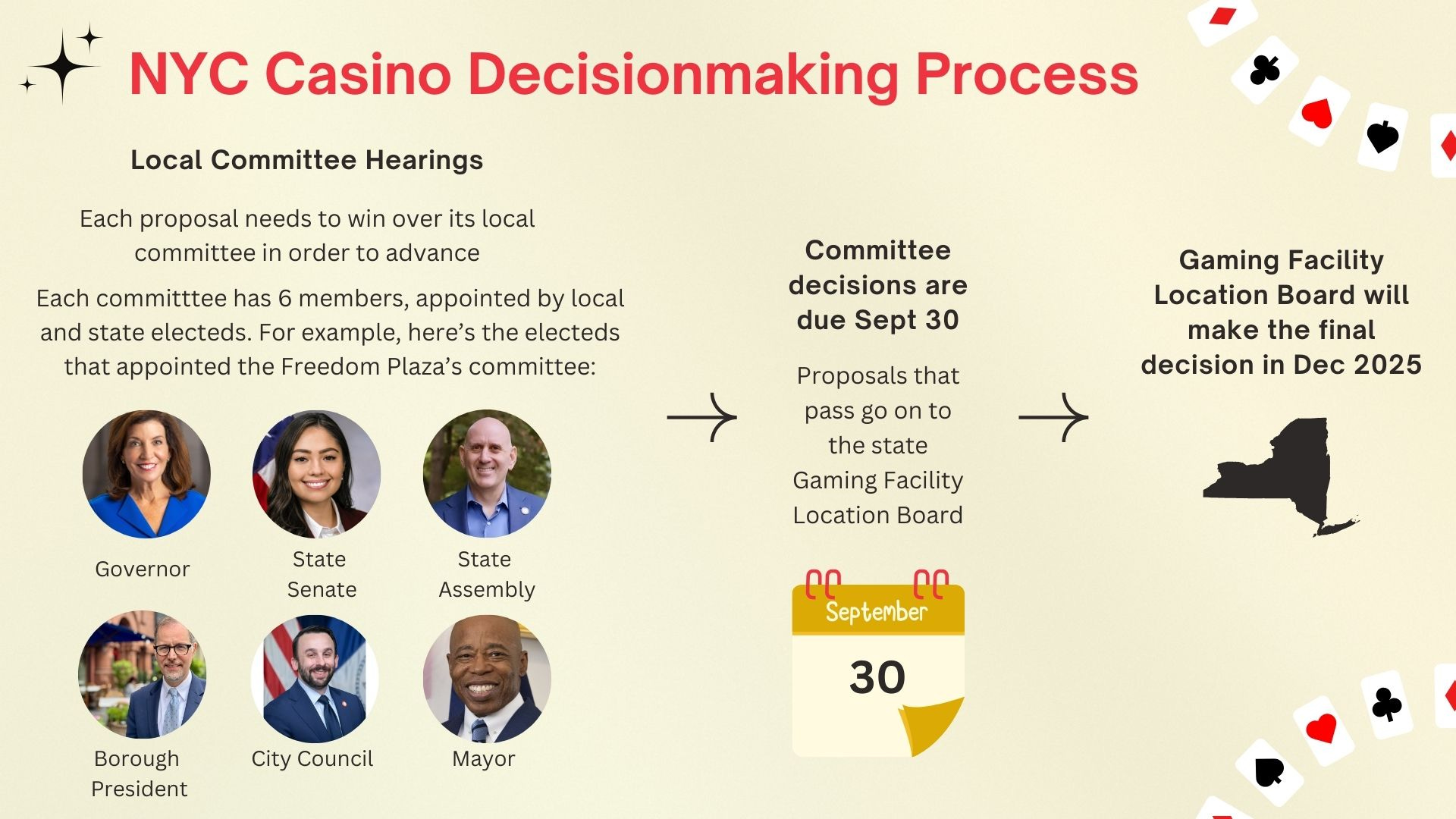
The CACs are holding public hearings through the end of September to allow locals to weigh in on each casino proposal– so basically casinos need to get through local opposition in order to advance to the next step. Opposition can kill casinos at this stage, because the decision makers are representatives of local electeds, and local electeds care deeply about residents’ and unions’ perspectives.
How have neighbors influenced casino proposals so far?
Neighborhood opposition heavily influences proposals– multiple casino applicants pulled their proposals in the spring due to community opposition. The Friends of the High Line rallied supporters against the Hudson Yards casino, especially a tall podium that they claimed would block views of the city from the High Line. In response, the developer negotiated a new plan with the city that scraps the casino entirely. The new plan adds more apartments and office space instead. Whereas the casino plan included 1,500 housing units, the new plan includes 4,000 residences, 400 of which will be below market rate. That’s a great outcome for the community, due to their advocacy.

Hudson Yards isn’t the only project that faced opposition– most new casino proposals face tough headwinds. For example, one individual has gotten a ton of press for catching The Coney’s casino team off guard. Marissa Solomon is a Coney Island resident. She was vocal in community hearings about the proposed Coney Island casino, and was appointed to the CAC by her Assemblymember. In the first CAC meeting about The Coney, Marissa criticized the casino for advertising thousands of local jobs when only 200 jobs would come from the neighborhood. She expressed skepticism about the casino’s diversity commitments, citing the company’s less-than-diverse executive staff. Representatives appeared to be caught by surprise and did not have prepared answers for her points, other than to say that the process is collaborative and could result in changes.

In other cases, organized groups are coming to a head in competing advocacy campaigns. Over 150 people spoke at the Caesar’s Times Square committee hearing, which lasted 7 hours. Broadway theaters and Broadway union workers came out swinging against the casino, since they’re worried that the casino will steal Broadway audiences. Construction union workers and hotel union workers showed up in favor of the casino. In the end, supporters of the casino outnumbered those against it.

And there’s one proposal that has overwhelmingly positive support from locals. At the first committee hearing for the Resorts World proposal near JFK, the 40 public speakers from the community unanimously supported the project. Yes, they’ve received grants from Resorts World, so they’re incredibly biased, but there was also no opposition. That makes it hard for elected officials to negotiate. The local Assembly Member asked for more community investment, suggesting a $140 million community investment fund to support mental health services, addiction recovery, and public infrastructure beyond the casino grounds. But the casino knows they don’t have to negotiate if everyone is already good with the current proposal.

How you can weigh in
Members of the public can sign up to speak in person or submit written comments by email. Committees will give equal consideration to all submissions, regardless of whether submitted by email or in-person.
If you have a concern or suggestion, weigh in. Even if you don’t live in the neighborhood. Each CAC has a state-level representative appointed by the governor, so your voice counts if you live in New York state. Each CAC has a city-level representative appointed by the mayor, so your voice counts if you live in NYC. Each CAC has a borough-level representative appointed by the borough president, so your voice counts if you live in the borough. I’m sending my form email to every CAC– feel free to steal my language below.
My email to the CACs
Subj: Recommendations to Reduce Harm from NYC Casinos
Dear Community Advisory Committee,
I am writing to share my concerns about how new casinos will impact problem gambling in New York City. Researchers at the University at Buffalo's Research Institute on Addictions found that casinos have a significant effect on problem gambling (90% increase) on residents within 10 miles. And those living in disadvantaged neighborhoods reported much higher rates of problem gambling (10%) than those not living in disadvantaged neighborhoods (1%).
Other countries, like Singapore, have taken problem gambling seriously and implemented effective safeguards. Their approach shows us what’s possible:
Requiring all casino advertisements to be government-approved and banning ads that target locals.
Mandating responsible gambling practices, including caps on betting and gambler-set time or expenditure limits.
Charging steep entry fees for local residents while allowing tourists to enter freely—ensuring casinos are funded by visitors, not neighbors.
New York should adopt these same principles. Any downstate casino license should include:
Strict rules to manage betting amounts.
A ban on local-targeted advertising.
Tools that allow gamblers to set firm limits on time and spending.
A significant entry tax or fee for New York residents.
Imagine the casino charges a $200 fee for NY state residents to enter. This actually makes sense– we tax things that create social and economic costs to society, like cigarettes. And this works. When you make a bad thing more expensive, people consume less. Since local residents are more likely to fall prey to problem gambling, an entry fee is a deterrent from starting. Let’s bring in tax revenue from tourists instead of neighbors from disadvantaged neighborhoods.
The current competition among operators for licenses gives the state and local residents rare leverage to demand these protections. We should not waste this moment.
Thank you for your consideration.
Casino Committee Meeting Times and Contact Information
The Avenir (Hell’s Kitchen, near Javits Center)
September 8, 2025 at 12 pm – Hearing Details
TheAvenirPublicComment@nystec.com
Bally’s Bronx Casino
September 9, 2025 at 6 pm - Hearing Details
BallysNYPublicComment@nystec.com
Caesars Palace Times Square
September 11, 2025 at 2 pm – Hearing Details
CaesarsTimesSqPublicComment@nystec.com
The Coney
Freedom Plaza (Manhattan’s East Side, by the UN)
September 15, 2025 at 9 am – Hearing Details
FreedomPlazaPublicComment@nystec.com
Hard Rock Metropolitan Park at Citi field
September 9, 2025 at 4 pm – Hearing Details
September 16, 2025 at 10 am – Hearing Details
MetropolitanParkPublicComment@nystec.com
MGM Empire City (Yonkers)
September 16, 2025 at 6 pm - Hearing Details
Resorts World (Queens, by JFK)
September 15, 2025 at 4 pm - Hearing Details
ResortsWorldNYCPublicComment@nystec.com
You're an angel for making this so easy
The Avenir casino time has been changed to this evening!