
My November 2025 Voter Guide
Here's how I’m voting in the general election.

Voter guide below, and see here for my video on how the housing proposals came to be on your ballot, plus explainers for Proposal 3 and Proposal 4.

Ballot Proposals
TLDR: I’m voting Yes on all 6 proposals.
Proposal 1. Olympic Skiing in Essex County
The New York State Constitution currently protects this portion of state land to be “forever kept wild.” But an Olympic sports complex wants to expand into that land. In exchange for allowing the facility to expand into 323 acres of the preserve, the state will purchase 2,500 acres of Adirondacks land to add to the preserve.
Vote Yes on Proposal 1.
Proposal 2. Fast Track Affordable Housing
This one is the most complicated proposal because it’s two proposals in one. It’s solving multiple problems.
What’s the current state?
Problem #1
NYC has rules for what can be built, where, and how. These rules are called zoning regulations. If you want to build something that isn’t included in the zoning for that area, you need to go through a rezoning process to get your project approved.
The current rezoning process adds burdensome time and expense to 100% affordable housing. Let’s take one project as an example. A church wanted to build 83 units of affordable senior housing on their parking lot. It took 3.5 years to go through the rezoning process. And the extra reports needed to get elected officials to sign off on the project added $700,000 to the cost of building. Three and a half years and $700,000 dollars of extra process. To turn a church parking lot into 83 apartments for low income seniors.🙄
Problem #2
There are some parts of the city that are building a ton of housing. And other parts of the city that are building none.
Two years ago, City Council passed the Fair Housing Framework, which sets housing goals every five years for each of the 59 community districts. But it stops there. That’s all it can do: set goals. There’s nothing enforceable.
What’s the change that’s being proposed?
Addressing Problem #1
This proposal would fast track publicly financed 100% affordable housing projects. In this example, the church wouldn’t have to go through the full process. They could apply for the fast track.
The fast track still includes Community Board review and a hearing by the Board of Standards and Appeals. And yet the process is significantly quicker than today’s full rezoning process.
The fast track will only apply to:
100% affordable housing projects that are publicly financed (meaning this isn’t a “giveaway to private developers”)
Projects “compatible with neighborhood character.” This means the new building won’t feel totally out of place.
Addressing Problem #2
The city will rank community districts by how much affordable housing they’ve permitted in the previous five years. And then the 12 lowest-ranked districts—those that have built the least affordable housing—will be eligible for a special fast-track process.
It’s basically accountability. If your neighborhood isn’t meeting the targets for affordable housing, your process has to change.
You might be thinking: well a less dense neighborhood won’t be able to build as many units as a really dense neighborhood. You’re right. So this policy won’t be looking at the number of units built, but rather the rate of building relative to existing housing in that area.
The fast track will only apply to:
Outlier districts: the few that produce the least affordable housing and aren’t meeting their goals.
Projects that include permanently affordable housing
Projects that are adequately supported by transit, sewer, and other infrastructure
Recommendation
Vote Yes on Proposal 2.
This change will shave years off affordable housing approvals, and save taxpayer dollars since those are publicly financed projects.
We need more affordable housing everywhere, not just in certain neighborhoods. And because the second track includes privately financed housing, it could generate more total units than the first track, which is limited to publicly financed 100% affordable housing.
Proposal 3. Simplify Review of Modest Housing and Infrastructure Projects
What’s the current status?
Since the rezoning process is really long and uncertain, the process adds to the cost of building. That process is especially important when big changes are proposed, because big changes could have negative effects on lots of people.
But rezonings are sometimes needed for even small changes. Like adding a handful of units of housing. For these kinds of cases, today’s system doesn’t work. Those small changes aren’t getting proposed at all because they aren’t worth the hassle or the cost of the rezoning process.
Some climate infrastructure upgrades also have to go through the full rezoning process. Like raising the grade of a public street, or acquiring coastal property to build levees or seawalls, or installing solar on public property.
And anytime the city wants to build 100% affordable housing on city-owned land today, it goes through the full rezoning process.
What’s the change being proposed?
This policy would simplify the process for minor zoning changes, instead of dragging every small project through months of bureaucracy and wasting the city council’s time with these tiny changes. The proposed process goes down from 7.5 months to 3 months and still includes Community Board review. Here’s how the policy defines small changes:
In medium- and high-density areas, changes that increase units by 30% or less would be eligible for the 3-month process.
In low density areas, new projects would qualify if they’re 45 feet or less– that’s about 3 stories.
Any site going through the 3-month process would be required to include permanently affordable housing.
The simplified 3-month process would also apply to climate infrastructure upgrades and building 100% affordable housing on city-owned land.
Recommendation
Vote Yes on proposal 3. New Yorkers want to see more small contextual housing additions, but our current process doesn’t allow it. And removing red tape from climate infrastructure upgrades means our city agencies spend more time protecting us from floods, not jumping through bureaucratic hoops.
Proposal 4. Affordable Housing Appeals Board
What’s the current status?
When a rezoning is proposed in NYC, there’s one person who has control over whether it moves forward: the city council person for that district.
The city council vote is basically the last step in a rezoning.* Here’s how this vote goes: all of the other city council members defer to the council member who has the rezoning happening in their neighborhood. This is called “member deference.” Member deference gives a single council member the final say on building decisions in their district.
No law says that it has to be this way, it’s just what happens in practice. But you can see why. You scratch your colleague’s back when the rezoning is in their district, and they’ll follow you when the rezoning is in your district. It gives city council members more control over land use in their neighborhood.
And the political incentives are set up for council members to say no to new housing. Council members face the strongest pressure from people already living in their district — neighbors who worry about construction and traffic. These are their voters. This is who’s re-electing them. Saying no is politically safer than saying yes, even when the whole city desperately needs housing.
Within the current system, the power balances are set up to mostly reject new housing.
*Technically the mayor can veto the city council’s decision. But in practice the mayoral veto has been ineffectual. As a result, the City Council’s determination is essentially final.
What’s the change that’s being proposed?
This proposal would create an appeals board. If the Council rejects or kneecaps a project with affordable housing, the developer could appeal. The appeals board would have three members (or their designees):
The Mayor
The Council Speaker
The Borough President
If at least two of the three agree to let the project move forward, they would override the City Council’s decision.
And those three elected officials answer to all the voters in the whole borough or the whole city. So their incentive is to do what’s best for the borough and the city, not just what’s best for the 50 people that live next to the proposed project.
The appeals board process would only apply to projects that include affordable housing.
There’s no change to the Community Board review process– local neighbors still have the opportunity to weigh in to shape the project.
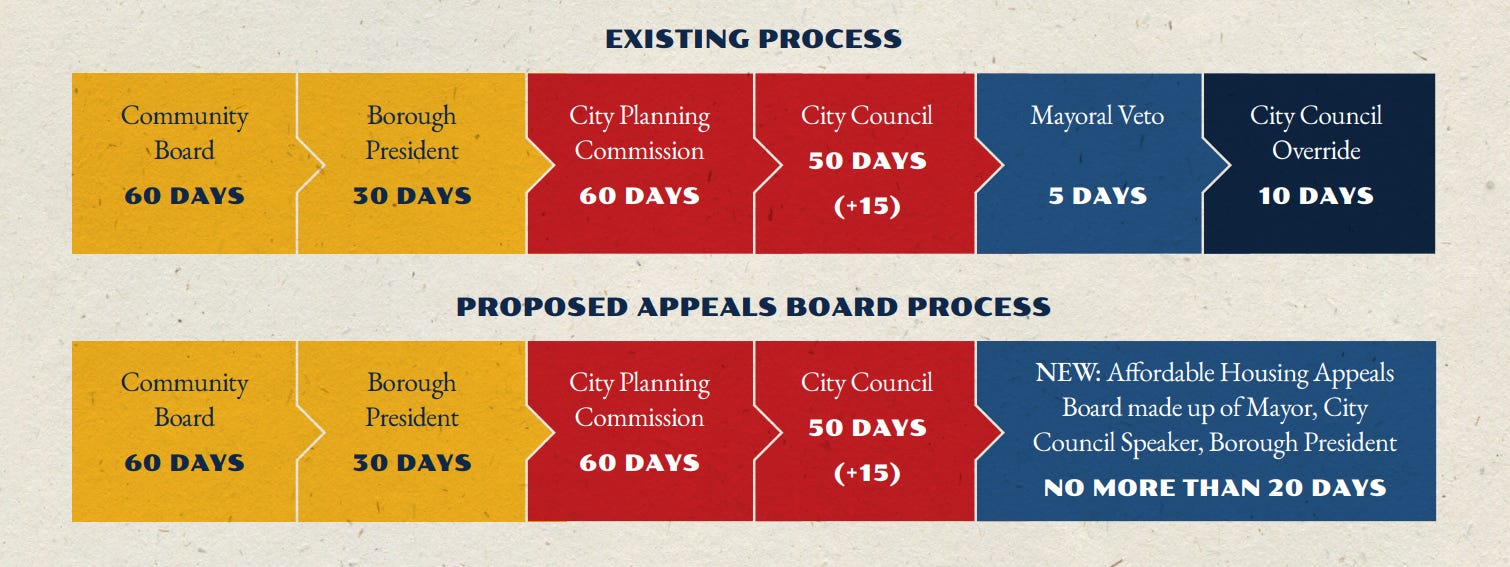
This proposal is more controversial because it takes away power from some groups. The groups that are opposed include Community Boards, unions, and other groups that use the current process to extract concessions from developers. And a lot of City Council members oppose this one, because it takes away their power over the process.
Recommendation
Vote Yes on Proposal 4. The appeals board’s incentives are aligned with citywide and boroughwide interests. Because affordable housing is a citywide and boroughwide priority, it makes sense to align interests that way. The status quo makes it difficult to build affordable housing, because new projects are always the most controversial to the neighbors (and therefore the Council Member) right next to the project.
Proposal 5. Create a Digital City Map
What’s the current status?
It’s important for the city map to be a source of truth for city planners. That includes information on everything from the width and slope of a street to the edge of a coastline.
Right now, each borough still maintains their own source of truth. The big issue with this is that the maps are maintained by borough president’s offices, which don’t have the staffing/processes necessary to implement updates in a timely manner. The slow pace of map updates imposes significant costs and time on infrastructure, housing, and other projects.
What’s the change that’s being proposed?
Instead of borough president’s offices owning each borough’s maps, it would make more sense for the Department of City Planning to oversee all city map changes. In order for them to do that, they’ll need to translate the individual borough maps into one unified city map (because currently each borough’s map has slightly different terminology, symbology, and scale). After the department unifies the map, they can digitize the unified version and legalize it so that the paper maps become fully obsolete.
Recommendation
Vote Yes on Proposal 5. This isn’t a controversial change. It’s on the ballot because that’s the only way to change the city charter, and who owns the maps happens to be encoded in the city charter.
Proposal 6. Move Local Elections to Even Years
What’s the current status?
NYC’s elections for mayor, city council, and other important local offices take place in odd years, while presidential elections take place in even years.
NYC’s local elections have poor voter turnout. While 53% of NYC registered voters cast a ballot in the 2024 presidential election, just 23% voted in 2021’s odd-year mayoral election.
What’s the change that’s being proposed?
This proposal would move city elections to the same year as presidential elections.
Moving local elections to even years would dramatically increase turnout, especially among younger voters, working-class communities, and voters of color.
Running elections is expensive, so consolidating will save taxpayer dollars. The Independent Budget Office estimates the switch could save the city $42 million every year.
Note: Even if voters approve this measure, it will not be able to take effect until State lawmakers sign off, and that will take years.
Recommendation
Vote Yes on Proposal 6. This reform will save money and help ensure that the voices shaping local government reflect the full diversity of our city.
Mayor
Zohran Mamdani.
I didn’t rank Mamdani in the primary, but today’s is a different ballot. A couple things that make me more optimistic about a Mamdani mayorship than a Cuomo one:
Mamdani wants to keep and learn from experienced and effective city agency leaders. He’s said he wants Jessica Tisch to stay on to continue to lead the NYPD, and he’s considering experienced leaders like Dan Garodnick, Maria Torres-Springer and Meera Joshi for first deputy mayor. On the other hand, Cuomo has a track record of getting in the way of effective bureaucrats instead of empowering them. The best mayors are those that set smart goals, hire good people, and support them to execute.
Mamdani can’t unilaterally raise NYC tax rates. NYC’s tax rates are decided by the state government, not the city. If Mamdani wants to increase NYC taxes, he’ll need to make the case in Albany. That won’t be easy. Governor Hochul has voiced concerns about Mamdani’s plan to increase taxes.
People are excited about Mamdani. He’s been able to mobilize voters that weren’t voting as much before and young people who had never volunteered on a campaign before. He drew thousands of people to participate in a scavenger hunt with NYC politics-themed destinations and clues. He’s inspiring optimism and civic energy where before there was a gaping black hole of apathy and cynicism.
I share Mamdani’s goal of inspiring more people to participate in NYC politics, and giving them reason to think that their voice makes a difference.
Thank for you voting YES on the ballot proposals!