
How lawsuits cost New York City billions of dollars a year
And what the Comptroller’s office can do to reduce them

I’m sharing the topics I’m exploring to build a stronger foundation for serving on the NYC’s Comptroller transition committee. I’m sharing what I learn along the way, so thanks for joining me in my research on Comptroller-related topics!

Why are we talking about settlement claims?
In this context, claims are requests made against the City, for things like causing an injury, damage, or rights violation. The claim is that the City should pay money or fix the harm. Claims are formal legal complaints filed by residents, employees, or businesses.
Claims are expensive. NYC paid out ~$2B in settled claims in FY2025.
For reference, the city’s full budget for FY2025 is $112 billion. Settled claims are almost 2% of the entire city budget.
As another data point for context, the city’s 3-K and pre-K systems cost $1.6 billion. Yes, we spending more on settling claims than on educating 3 and 4 year olds.
The Comptroller manages and settles claims filed against NYC. As the city’s fiscal watchdog, the Comptroller’s office uses claims data to spot recurring problems and recommend policy and practice reforms that reduce liability.
In this post, let’s dig into:
What are some of the most expensive categories of claims?
What are some solutions?
What are some of the most expensive categories of claims?
In 2025, Comptroller Brad Lander replaced the annual Claims Reports with this sweet dashboard. I used the dashboard to look at the 3 most expensive categories of claims for FY2024.
The most expensive bucket was salary claims at $440M
Salary claims made up 22% of the $2B total for settled claims. Salary claims are requests for unpaid wages or legal fees from current, former, or prospective City employees who say the City treated them unfairly at work. These claims can involve issues like discrimination, being asked to do work outside their job title, incorrect pay, or problems with leave time.
There aren’t actually that many salary settlements each year, but the settlements that happen are really expensive. Here’s the top 10 most expensive settlements for FY 2024:
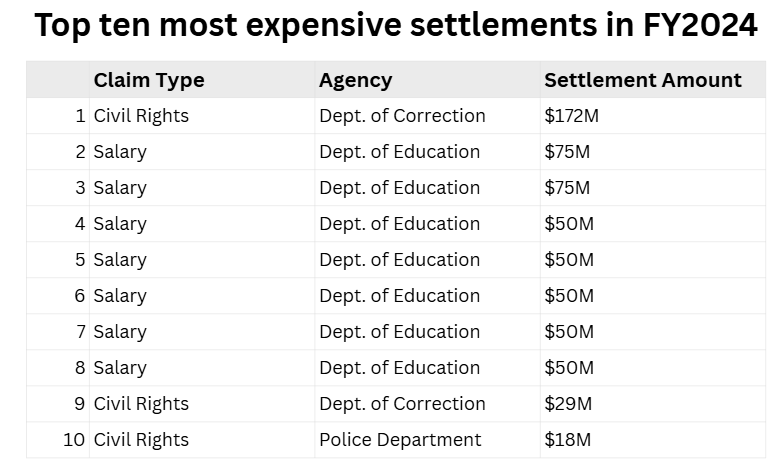
In FY2024, there were only 18 salary settlements. But the total payout was $440M across those 18, and these 7 claims in the table above were $400M of that.
A good portion of that $400M is due to one class action lawsuit. In the Gulino class action lawsuit filed against the Dept. of Education in 1996, the court found that state-mandated teacher certification exams discriminated against Black and Latino teachers. The City is scheduled to deliver payments over seven years, across FYs 2022 to 2028, up to about $1.4B total. Since payments will continue for this class action through FY 2028, we can expect salary claims to remain a significant category. But hopefully in the future, salary claims go back down to pre-Gulino levels, which could be as low as $8M per year.
The second most expensive bucket was special education claims at $425M
Under federal and state law, NYC is legally mandated to provide special education services to children with disabilities. These services include speech therapy, occupational therapy, specialized individual instruction, and more. Where the City fails to provide these services directly, families can file claims to make the City either provide the services or to pay the costs to families to arrange these services.
The City’s spending on special education claims is dramatically higher than other cities. In fact, in 2021, NYC represented more than 60% of all special education claims filed in the entire US.
One reason for the huge difference is that New York law guarantees special education services for private school students. Including students who have opted out of the public school system for reasons other than special education services. So if you opted to send your kid to an elite private school or a Catholic school because that’s your family’s preference, the public school doesn’t get funding for serving your kids academic needs. But the public school is still on the hook for paying for your kid’s special education needs. It’s a public subsidy to private schools. Which doesn’t make much sense. That’s why other states don’t have this rule. In Jersey, if you opt out of the public system, you don’t get any of its benefits.
This not only leads to higher special education costs in NYC, but also fraud. A couple years ago, The New York Times investigated the growing number of claims that disproportionately came from Orthodox Jewish neighborhoods, where private education companies were billing for services that were not needed, or even provided.
The current system also has inequities in who receives services: Black and Hispanic students are less likely to receive the special education services they need.
A couple years ago, Comptroller Brad Lander made a series of recommendations to expand district special education staffing, increase the amount of the voucher, and require accreditation of service providers to prevent fraud. These recommendations would decrease settlement payments for special education, but balloon spending in other areas.
My take: the city should do the math on the true cost of Lander’s proposals, and also push Albany to end the rule that requires public schools to provide special education services to private school students.
The third most expensive bucket was civil rights claims at $412M
Civil rights claims include alleged violations like discrimination based on sex/gender, race, religion, disability, or age. Civil rights claims against NYPD and the Dept. of Corrections can also include allegations of false arrest, malicious prosecution, or excessive force.
A good portion of the $412M comes from reversed conviction cases. A reversed conviction happens when someone is convicted of a crime, then they appeal that conviction, and then a higher court reverses the original conviction. These cases can go on for a long time, and the longer someone is incarcerated before their reversal, the more expensive the settlement to the City. For example, one person was incarcerated for 20 years before his conviction was reversed, and his settlement was $13 million from the City.
Another class action lawsuit increased civil rights claim payouts in FY2024. The lawsuit found that NYC violated the law by not releasing people in a timely manner after they paid bail. When people aren’t released in a timely manner, they can miss work and lose jobs, which adds up to a high settlement amount across lots of people. This case is smaller than the salary class action lawsuit I mentioned before, and it won’t stretch out payments across multiple years.
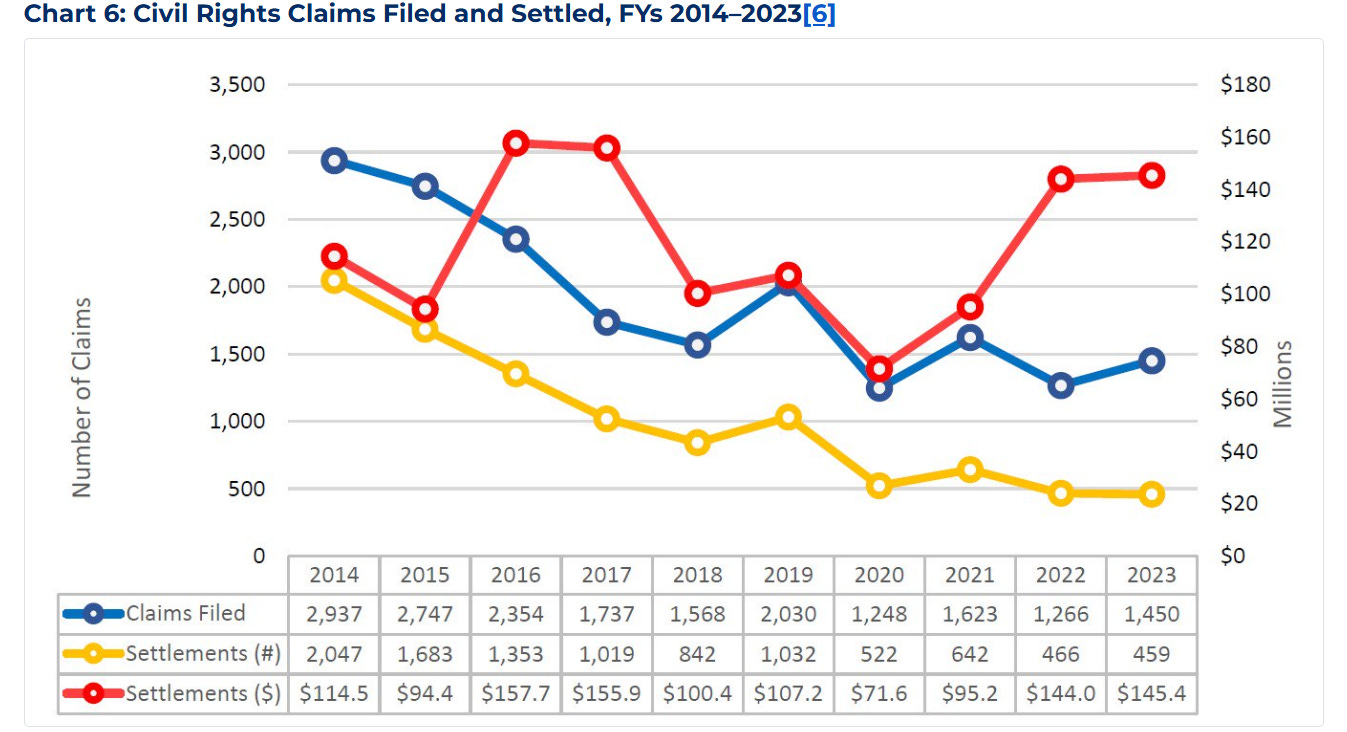
Oddly, the number of civil rights claims has been decreasing over time, but the settlement amounts and overall costs have increased. I can’t find any hints to explain either of these trends in Lander’s or Stringer’s reports, and I can’t find more granular data to figure it out myself. Let me know if you have suggestions.
Solutions
One step in the right direction would be for agencies to internalize the cost of settlements. Today, settlement claims are paid out of the General Fund, so departments have little incentive to prevent future claims. It’s a bit like telling your child that if they misbehave, someone else will pay the consequences. There’s no direct connection between their actions and the cost, so the behavior doesn’t change.
The challenge here is that some of these class action lawsuits would blow huge holes in agency budgets when they hit. If the agency has to pay out a large unexpected amount, they might have to cut services mid-year. Paying from the General Fund smooths out the impact of big settlements.
But we could also smooth out the impact by having the General Fund pay up front, and then charging the agencies back for the same amount later.
And because it’s hard to make big changes all at once, what if we started with a small pilot? Pick a couple categories of claims and just start implementing agency charge-backs for those. Pick the categories that we think are most preventable. Watermain breaks cost the city $6M in claims last year. Sewer overflow claims were $470K. Piloting agency charge-backs for a couple categories of claims would empower agencies to find creative solutions.
Insightful, concise, and approachable read, thank you!