
Property Taxes 101: What Every New Yorker Should Know
The system that funds a third of our city budget and shapes our housing crisis

I’m sharing the topics I’m exploring to build a stronger foundation for serving on the NYC’s Comptroller transition committee. I’m sharing what I learn along the way, so thanks for joining me in my research on Comptroller-related topics!
I’m serving on the next NYC Comptroller’s Transition Committee

I’m honored to serve on Mark Levine’s transition committee as he prepares to begin his new role of New York City Comptroller.
Why are we talking about property tax?
Multiple administrations of City leaders have acknowledged that our property tax system is broken: de Blasio put together a commission to give recommendations to fix it. Adams said he’d make it a priority. Mamdani is “serious about property tax reform”:
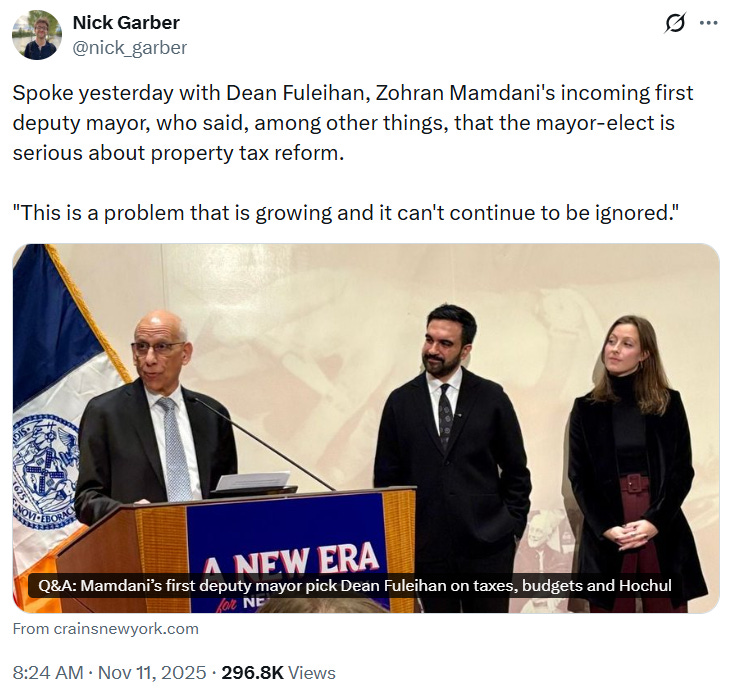
Mayoral support for property tax reform will be critical, and so will the Comptroller’s influence. The Comptroller has an important role to play, since property tax pays for about one third of New York City’s budget- this is the revenue that funds our schools, streets, and sanitation services.
Our incoming Comptroller, Mark Levine, is well-positioned to be an effective leader in this policy area. Reforming a system as complex as property tax is not simple- any change will involve tradeoffs that affect different groups in different ways. Levine has a track record of using data and evidence to weigh tradeoffs and craft policies that prioritize the public good over special interests, safeguard the city’s future, and protect our most vulnerable neighbors.
Neither the Comptroller nor the Mayor directly control NYC’s property tax rates, but change will still require their advocacy and influence.
Technically the state controls NYC’s property tax rates, but state lawmakers have said that they want NYC electeds to lead the charge on policy solutions.
Here’s what you need to know about property taxes in order to get up to speed on the discussion. This post will cover:
Why tax property?
What are the characteristics of the ideal property tax system?
How does NYC’s property tax system rate?
Does it maintain a reliable, sustainable, and diverse revenue stream?
Is it simple and transparent?
Does it tax similar properties similarly?
Do those with greater ability to pay shoulder more of the tax burden?
Is it economically competitive?
Reflections and Recommendations
Why tax property?
Governments use multiple tax levers to bring in revenue to run public services (e.g. sales tax, income tax). Taxing property makes sense for a couple reasons:
It tends to be progressive– we can tax wealthier people at higher rates
When real estate values increase, the public sector can share in the benefits. This especially makes sense when public investment leads to increases in real estate values (e.g. a new subway station makes your apartment worth more)
What are the characteristics of the ideal property tax system?
Any property tax system should:
Maintain a reliable, sustainable, and diverse revenue stream
Be simple and transparent
Be economically competitive (the tax doesn’t put the city wildly out of line with other cities)
Be fair. Fairness is the trickiest one to define, since different people could reasonably have different ideas of what’s fair. I’m going to use this definition:
Similar properties should be taxed similarly
Those with greater ability to pay shoulder more of the tax burden
Let’s use those ideal characteristics above and see how NYC’s system does.
How does NYC’s property tax system rate?
Does NYC’s property tax system maintain a reliable, sustainable, and diverse revenue stream?
✅ Yes! About a third of the City budget is covered by property taxes, and property tax revenue is less volatile than other types of taxes like income taxes and real property transfer taxes.
Is NYC’s property tax system simple and transparent?
❌ No. It’s notoriously opaque and confusing.
Here’s my very quick rendition of how it works, and some resources if you want to learn more:
First, the NYC Department of Finance estimates a property’s market value: how much it’s worth.
Next, the department calculates the tax for each property owner.
There are 4 classes of property in NYC that are taxed in different ways:
Class 1: Most residential property of up to three units and most condos under three stories
Class 2: Residential property with more than 3 units, including co-ops, condos, and rentals
Class 3: Larger rental buildings and utilities
Class 4: Commercial/industrial properties
The classes have different tax rates. Different types of properties also have limits on how quickly tax bills can increase and by how much.
Different types of properties are also eligible for exemptions or abatements
The biggest issues that make the system confusing are:
How the Department of Finance estimates how much a property is worth. They use different methodologies for each class, which makes sense, but their methodologies are more transparent and effective for some classes than for others. For example, for Class 1 homes, the department uses data from sales of comparable properties, which works well. But co-ops and condos are valued based on the income stream of comparable rental buildings, which tends to lead to inaccurate valuations.
Lots of exemptions and abatements have been enacted over the years, and that makes it confusing to understand how the whole thing works.
Also, the majority of NYC households are renters (67%), and renters just don’t know how much we pay in property tax. Renters still pay property tax, since landlords pass that cost on to tenants. It’s included in our rent bills, but it’s impossible to tell how much of the rent is actually property tax. This renter transparency issue isn’t unique to NYC, but it does help the current system persist– because with such a high rate of renters, NYC has more households that are unaware of how much of our budget goes to property tax.
Resources
Want to find out what property tax class your building is in, its market value and its assessed value? Search by address in the Department of Finance’s handy tool.
Does NYC’s property tax system tax similar properties similarly?
❌No.
We tax a single home similar to another single family home, but very differently than a condo or co-op or rental apartment.
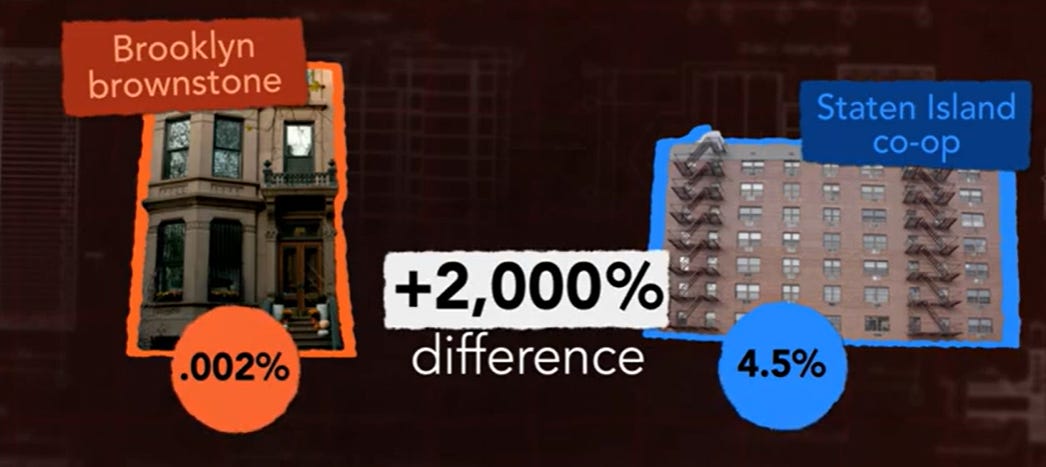
What ends up happening is that the family living in the single family home pays a lower effective property tax rate than the family living in the condo.
I highly recommend this 7-minute video on How Unfair Property Taxes Crush New Yorkers from Bloomberg Law. They walk through an example of how a Brooklyn brownstone and a Staten Island co-op with similar market values pay property taxes that are 2000% different. The TLDR is that Class 1 properties (1-3 unit houses) pay lower effective property tax rates.
Do those with greater ability to pay shoulder more of the tax burden?
❌No.
Sebastian at Sidewalk Chorus wrote a great post on this, and he said it well:
“Our property tax system disproportionately burdens apartment residents with higher tax rates than single-family homeowners. Not only is this unfair, it’s also regressive: New York charges its least wealthy homeowners higher tax rates than its most wealthy. This contradicts the conventional wisdom of taxing the wealthy at higher rates to fund public services.”
NYC Comptroller Brad Lander agrees:
“The current property tax system significantly favors wealthy neighborhoods over working class people: homeowners in Staten Island, Southeast Queens, Eastern Brooklyn, and the Northeast Bronx sometimes pay three times the effective tax rate of homeowners in Manhattan and brownstone Brooklyn.”
The fact that NYC’s property tax system disadvantages lower-income people isn’t controversial, it’s just really hard to change. Because reform would mean that wealthier homeowners (AKA voters that reliably turn out at every election) would pay higher property taxes.
Is NYC’s property tax system economically competitive?
🤔Overall, no. But there’s tradeoffs here.
➕ Because NYC’s property tax system benefits wealthy homeowners, you could argue that it keeps more of those folks in NYC rather than moving to NJ or CT. NYC already has the highest income tax rate in the country, so if we also had high property tax rates, we might see an exodus of some of our top taxpayers. That’s an important consideration, since taxes on top earners make up a disproportionate amount of our budget. If they move, we lose city and state revenue.
➖But the unfair property tax system negatively impacts our economy by exacerbating our housing crisis. When workers and families can’t afford to live in NYC, employers face staffing shortages and the city loses residents who drive innovation, growth, and tax revenue.
But how does the property tax system exacerbate the housing crisis?
The tax code discourages housing construction.
The current system taxes large rental apartment buildings at a much higher effective rate than comparable condos and single-family homes. This disparity creates a substantial barrier to building new rental housing.
The tax code also discourages constructing buildings above 10 units. Smaller buildings with 10 or fewer apartments have limits on how quickly their property taxes can go up (no more than 6% per year and no more than 20% over five years). That’s not the case for buildings with 11 or more units, where there’s no limit on tax increases. This creates a disincentive to add an 11th apartment, suppressing the construction of mid-sized or larger multi-family buildings.
Reflections and Recommendations
NYC’s property tax system fails 4 out of my 5 “ideal tax policy” criteria. But it’s hard to change because it does maintain a reliable revenue stream, so there isn’t an urgent need for far-reaching reform. It’s also hard to change because reform would negatively impact a big block of important voters.
I do think the Mamdani-and-Levine combo have the best chance at taking a whack at property tax reform, given that Mamdani cares less than previous mayors about pissing off wealthy homeowners and Levine has consistently been a champion in favor of housing affordability.
But my research also led me to conclude that property tax reform will take a lot of political capital. These are not the kinds of policies that elected officials usually tackle in their first term, if at all.
If and when the Mayor or Comptroller want to go in for the fight, there’s already been a city commission that studied the problem, went around all the boroughs collecting public comment, and made recommendations for improvement. The New York City Advisory Commission on Property Tax Reform made 10 recommendations to the de Blasio administration, including:
Create a new tax category for small residential property owners. This would group together 1–3 family homes, condos, co-ops, and small rental buildings with 4–10 units so they all follow the same rules, no matter the type of property.
Value properties in this new category based on actual sales. This would end the current rule that requires condos and co-ops to be valued as if they were rental buildings.
Eliminate the limits on how much a property’s assessed value can go up each year. These limits are widely seen as a major cause of unfairness in the system.
I’m curious what this post brings up for you— are there other resources you think I should read? Other research questions I should dig into next? Leave me a comment or shoot me an email!
Such a well laid out distillation of problems in NYC’s property tax code. I would love to see a similar analysis applied to other U.S. cities to get a feel for which ones are hitting more of the points you mentioned and which are not. This is something that should be utilized by YIMBYs nationwide.
Thank you, Sachi! My white whale. I do have a question. Will reform of the property tax system (most likely along the lines of the Blasio commission’s recommendations) change the overall amount of property tax the city takes in?